
My FTMO Journey | Trader's Journal | TradeReview Pro
Trading period: 3–4 November 2026
Account: $10,000 FTMO Instant Account
Instruments: GBPJPY, GBPCAD, AUDJPY
Performance source: FTMO MT5 trading history, 4 November 2026
Three Trades, Three Different Decisions
Over the past two trading days, I experienced three situations that made me think more carefully about how I enter and manage my trades.
One position was closed at breakeven before price eventually reached my intended target.
Another trade ended profitably after I deliberately allowed the market room to fluctuate.
The third resulted in a loss, even though the market eventually moved in the direction I had anticipated.
These experiences reminded me of something important.
Being right about market direction is not necessarily enough to produce a profitable trade.
The timing of my entry, the placement of my stop loss and the decisions I make while a position is open can all influence the final result.
What interested me most was that each of these trades involved a different decision about when to wait and when to act.
GBPJPY — My Target Was Reached, But I Was Already Out
On 3 November, I entered a buy position on GBPJPY.
My intended take-profit level was 212.100.
I had assessed the opportunity against my trading criteria and considered the setup valid.
After entering, I decided to move my stop loss to breakeven to protect the position.
However, price pulled back and triggered the adjusted stop.
My trade closed with a small profit, but I was no longer participating in the movement I had anticipated.
What happened afterward caught my attention.
GBPJPY eventually reached my original take-profit level of 212.100.
The market had moved toward the target I selected, but my position had already been closed.
Looking back, I believe I moved my stop loss to breakeven too early.
I was concerned that price might reverse, so I attempted to protect the position before allowing enough room for the market to fluctuate.
Yet the trading setup itself had not necessarily been invalidated by that temporary movement.
This made me reconsider whether I was giving enough importance to the difference between an ordinary pullback and a genuine change in the market conditions supporting my trade.
Moving a stop loss to breakeven can reduce the potential loss on an open position, but it also changes how much price movement the position can tolerate.
If the adjustment is made too early, a normal retest of the entry area may close a trade before the anticipated movement develops.
That was the situation I believed I had experienced with GBPJPY.
However, I also recognize that price reaching my target afterward does not automatically prove that moving the stop was wrong.
The decision needs to be judged against the information available when I made it, not simply against the eventual outcome.
Still, the experience gave me something specific to reconsider before my next trade.
AUDJPY — Allowing the Market Room to Move
On 4 November, I traded AUDJPY using the same general setup principles I had applied to GBPJPY.
This time, my approach to managing the stop loss was different.
I did not move it to breakeven prematurely.
It was not because I was struggling to resist the temptation.
I had already considered the possibility that price might move back toward my entry level before continuing in the anticipated direction.
Based on my analysis and the confluence supporting the trade, I believed the position should be given room to fluctuate without necessarily reaching its original stop loss.
I was comfortable allowing that movement while the original trading idea remained valid.
The position was a sell trade on AUDJPY.
AUDJPY Trade Record
| Trade detail | Result |
|---|---|
| Direction | Sell |
| Position size | 0.60 lot |
| Entry price | 110.501 |
| Closing price | 110.032 |
| Favorable movement captured | 46.9 pips |
| Gross profit | +$177.09 |
Source: FTMO MT5 trading history, 4 November 2026. Gross profit is shown before applicable commission.
The trade eventually closed profitably.
What made the experience meaningful to me was not only the result.
It was the decision to leave the original stop-loss arrangement in place rather than immediately adjusting it to breakeven.
After the earlier GBPJPY experience, I had become more aware that a price retest does not necessarily mean the trading idea has failed.
For AUDJPY, I wanted to allow the market sufficient room to develop while respecting my original risk boundary.
I believe an earlier breakeven adjustment might have closed the trade before the favorable movement developed.
However, I cannot establish that alternative outcome without reviewing the exact intraday price movement and the hypothetical adjustment timing.
This experience does not mean I should always leave my stop loss unchanged.
It means that my decision to adjust a stop should have a reason that is consistent with the market conditions and the trading plan.
The profitable outcome was encouraging, but the more important point was that I had made a deliberate decision about how much room the position needed.
GBPCAD — Correct Direction, Wrong Entry
My GBPCAD trade presented a different challenge.
During the London session on 3 November, I was anticipating a bullish breakout.
I expected the market to develop upward momentum.
However, when I entered, price was still moving up and down. The breakout I anticipated had not yet properly developed.
I also had not waited for price to reach my preferred entry location.
Looking back, I recognize that fear of missing out influenced my decision.
I wanted to participate in the expected bullish movement before the opportunity disappeared.
Instead of waiting, I entered prematurely.
Almost immediately after my entry, price reversed.
That was when I reconsidered the position.
I knew I had not followed my preferred entry process. Rather than continue holding the position until the original stop loss was reached, I decided to close the trade and accept the loss.
GBPCAD Trade Record
| Trade detail | Result |
|---|---|
| Direction | Buy |
| Position size | 1.00 lot |
| Entry price | 1.87502 |
| Closing price | 1.87358 |
| Gross loss | −$103.81 |
Source: FTMO MT5 trading history, 3 November 2026. Gross loss is shown before applicable commission.
What happened afterward made the experience particularly interesting.
GBPCAD eventually broke upward, just as I had originally anticipated.
My directional expectation turned out to be correct.
But I had entered too early, experienced an unfavorable movement and closed the position before the anticipated breakout developed.
I do not believe the important lesson is that I should have held the position until the breakout occurred.
The mistake began before that.
I had not waited for the price location I wanted.
I allowed my expectation of a bullish breakout to influence my decision to participate before my preferred conditions were satisfied.
When the market initially moved against me, I recognized that the entry was not one I was comfortable defending.
I chose to accept the loss rather than continue holding a position that I believed should not have been opened at that price.
Whether closing early was the best financial outcome cannot be established from the eventual breakout alone.
But I can identify the execution mistake that led to the situation.
I anticipated the direction correctly, but I did not wait for the entry I wanted.
That is what I need to remember.
What the Three Trades Reveal
Looking at the three trades together, I see three different decisions.
With GBPJPY, I had confidence in the setup but moved my stop loss to breakeven before allowing enough room for a possible pullback.
With AUDJPY, I trusted the qualified setup and allowed the position to fluctuate within its original risk boundary.
With GBPCAD, I anticipated a breakout but entered prematurely because I did not want to miss the opportunity.
The outcomes were different, but they all brought me back to the same question.
Am I allowing my trading plan to guide my decisions, or am I reacting too quickly to what price is doing?
For GBPJPY, I reacted by protecting the position early.
For AUDJPY, I was prepared for a possible retest and did not interfere with the position simply because price might fluctuate.
For GBPCAD, I acted before the market reached my preferred entry location.
This has helped me recognize that patience is not a single decision.
There is patience before entry.
There is patience while a valid position is developing.
And there is also the discipline to recognize when a trade no longer deserves to remain open.
Those situations require different judgments.
This Week's Trading Results
The FTMO trading history records the following three positions for 3–4 November.
| Instrument | Direction | Gross result |
|---|---|---|
| GBPJPY | Buy | +$16.34 |
| GBPCAD | Buy | −$103.81 |
| AUDJPY | Sell | +$177.09 |
| Total gross result | +$89.62 | |
| Commission | −$18.00 | |
| Net result | +$71.62 |
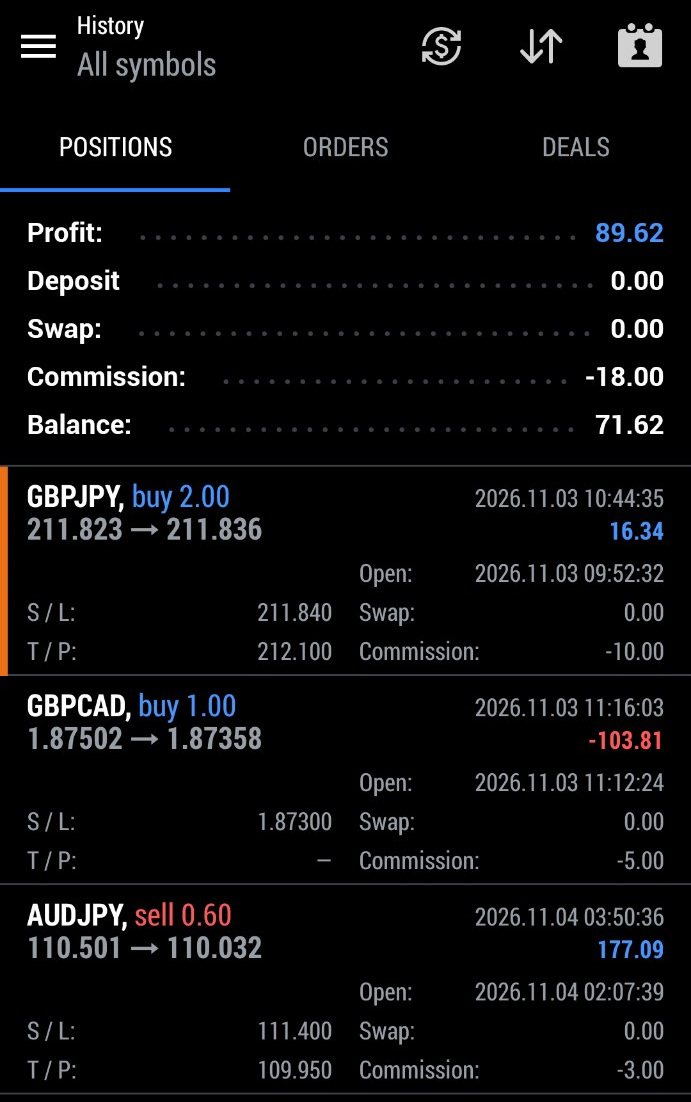
Source: FTMO MT5 trading history screenshot, 4 November 2026. This table reflects the three positions shown in the provided record, not necessarily every trade during the calendar week.
The combined net result was positive.
However, I do not want to judge the quality of these decisions simply because the total finished above zero.
The GBPCAD trade was a loss associated with an entry I should have waited for.
The GBPJPY trade closed with a small gain, but I believe my stop-loss adjustment may have been premature.
The AUDJPY trade produced the largest profit of the three, and I was more deliberate about allowing the position room to develop.
These observations are more useful to me than the combined profit figure alone.
They show areas of my trade management that deserve further attention.
Patience Before Entry, Patience After Entry
One of my main objectives in trading is to become more consistent in how I apply my trading plan.
That does not mean I expect every qualified trade to make money.
Even a carefully selected position can fail.
But I want to reduce situations where my own decisions interfere with the process I intended to follow.
The GBPCAD trade reminded me that anticipating a breakout is not a reason to enter before my preferred conditions are present.
If price does not reach the location I want, I need to accept that I may miss the opportunity.
The GBPJPY trade reminded me that moving a stop loss too quickly may prevent a position from tolerating an ordinary pullback.
And AUDJPY gave me an example of what it was like to remain with the original risk plan while allowing the market room to develop.
At the same time, allowing a position room does not mean ignoring losses or refusing to reassess a trade.
A stop loss still defines risk, and a trading idea can still become invalid.
The challenge is to distinguish those situations from ordinary price movement without relying only on fear, hope or the eventual outcome.
My Reflection
The most important lesson from these trades is not that I should always hold longer or always close losing trades early.
It is that the reason behind each decision matters.
If a setup is qualified, I need to understand the price movement it may reasonably experience before deciding to interfere with the position.
If an entry does not meet my intended conditions, I need to recognize that before placing the trade rather than hoping the market will justify my decision afterward.
And if the market changes in a way that genuinely undermines the trade, I must be willing to reassess the position rather than defend it simply because I am already involved.
The past two days showed me all three situations.
Two trades closed with gains. One ended with a loss.
But the financial results alone do not tell the complete story.
A profitable position can still reveal an area for improvement.
A losing trade can expose an execution mistake worth correcting.
For me, that is the value of maintaining this journal.
I want to examine what I actually did, not just what the market eventually did.
Sometimes I need to wait longer before entering. Sometimes I need to give a valid trade more room after entering. And sometimes I need to accept that I made a mistake and close the position.
Learning to distinguish between these situations is part of the journey.
Looking Ahead
My personal objective remains approximately 3% per month.
But I do not want that target to determine how frequently I trade or how much risk I take.
These recent trades have given me several things to evaluate as I continue developing my trading consistency.
I want to pay closer attention to entry quality, the timing of stop-loss adjustments and whether my decisions remain consistent with the trading plan.
I also want to understand whether the improvements I believe I am making are reflected in actual results over a larger sample of trades.
Three positions are not enough to establish that.
The next trades may confirm some of my observations or challenge them.
Either outcome is worth documenting.
For now, the lesson I take from this week is straightforward:
I do not need to participate in every anticipated move. But when I do have a qualified position, I need to give it a fair opportunity to develop within my intended risk limits.
That is something I intend to keep working on.
About My FTMO Journey
My FTMO Journey documents selected personal trading experiences, account performance and lessons learned using an FTMO Instant Account.
The journal includes both profitable and losing periods. Trading decisions and personal reflections are distinguished from verified performance statistics.
Important Disclosure
FTMO accounts use simulated trading capital. Performance figures discussed in this journal represent simulated trading results and should not be interpreted as returns from a live brokerage investment account.
Any eligibility for monetary rewards is subject to FTMO's applicable trading objectives and account conditions.
The personal 3% monthly objective is not guaranteed, is not an FTMO requirement and does not represent a typical or expected return.
This article is provided for educational and informational purposes only. It is not financial advice, a trading recommendation, a trade-signal service or an invitation to copy trading activities.
Past performance does not guarantee future outcomes.
TradeReview Pro is an independent educational and trading-review platform. It is not affiliated with, sponsored by or endorsed by FTMO.