
My FTMO Journey | Trader's Journal | TradeReview Pro
Trading date: 30 October 2026
Instrument: USDJPY
Account: $10,000 FTMO Instant Account
Performance snapshot: 31 October 2026
The Market Moved in My Direction. But Would I Keep the Profit?
Friday, 30 October, gave me something worth reflecting on.
After the series of losses documented in my first two journal entries, I had been thinking about how I approached the market, particularly how I managed a trade after entering it.
One situation had become familiar to me.
I could identify a market direction, enter a trade and watch price move favorably. But markets are volatile. A breakout does not always continue uninterrupted. Sometimes price pulls back sharply, and a position that was previously profitable can return toward its entry.
That raised a question.
What is the value of being right about market direction if I cannot consistently turn that movement into realized profit?
I began looking at the problem differently.
Instead of concentrating only on how far price might eventually travel, I wanted to think more carefully about the movement available during a trading session, how much I was risking and when it made sense to close a position.
Friday's USDJPY trade became a practical example of that thinking.
Why I Was Reconsidering My Approach
My preferred trading period is the European and London session, particularly when trading major currency pairs.
I am interested in the intraday movement that can develop when price breaks through an area and extends toward a new high or low of the day.
But I have also observed that these movements can be followed by significant pullbacks.
Holding for a distant profit target may offer a larger potential reward, but that potential reward remains unrealized until the trade closes.
I began considering whether focusing on a more achievable intraday movement might suit me better than waiting for every trade to reach a much farther target.
This was also relevant to my FTMO account, where trading around certain news releases is restricted. I wanted to plan my trading activity around those conditions, although trading during London hours does not automatically avoid restricted economic announcements.
The approach I wanted to examine was relatively straightforward: identify a suitable intraday opportunity, use a controlled stop loss and manage the trade according to the movement developing during the session.
The idea was not to guarantee a higher win rate.
It was to see whether I could improve the relationship between the profits I actually realized and the losses I accepted.
Friday's USDJPY Sell Position
On 30 October, I entered a sell position on USDJPY.
My FTMO trading history recorded the following:
| Trade detail | FTMO record |
|---|---|
| Direction | Sell |
| Position size | 1.00 lot |
| Entry price | 157.619 |
| Original stop-loss distance | Approximately 20 pips, based on my trading notes |
| Final recorded stop loss | 157.600 |
| Take-profit price | 156.750 |
| Closing price | 157.188 |
| Favorable movement captured | 43.1 pips |
| Holding time | 5 hours, 8 minutes, 40 seconds |
| Gross profit | $272.27 |
| Commission | −$5.00 |
| Net realized profit | +$267.27 |
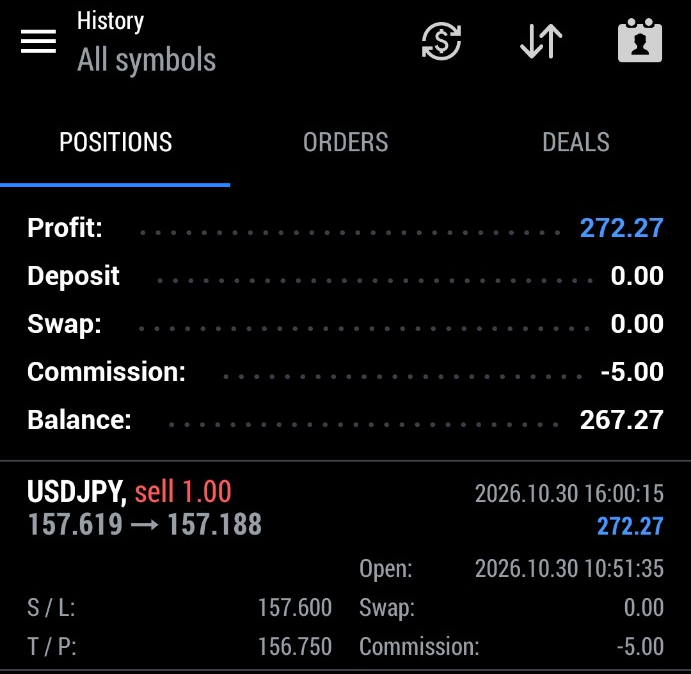
Source: FTMO MT5 trade-history record, 30 October 2026. The original stop-loss distance is based on my own account of the trade; the screenshot records the subsequently modified stop-loss level.
The original profit target was 156.750.
That meant I was initially looking for a much larger downward movement than the 43.1 pips I eventually captured.
But something important happened between entry and exit.
The trade moved in my favor, and I adjusted my stop loss close to breakeven, slightly beyond my original entry price.
I then allowed the position to continue through the session.
I was no longer simply waiting for the original take-profit level. I was also managing the profit that had already developed.
A Larger Lot Size Does Not Automatically Mean Greater Risk
Another part of Friday's trade was my position sizing.
Previously, I often used smaller positions with stop losses of approximately 50 pips.
For this trade, I used a 1.00-lot position with an initial stop-loss distance of approximately 20 pips.
My thinking was that a tighter stop loss could allow a larger position size while keeping the monetary risk within a defined amount.
A larger position could then produce a more meaningful dollar profit from a shorter intraday price movement.
But there is an important detail here.
Reducing the stop-loss distance does not automatically reduce the money at risk.
Both the stop-loss distance and position size matter.
For USDJPY, using an approximate value of $7 per pip for one standard lot, a 20-pip stop would represent approximately $140 of initial risk before trading costs.
On a $10,000 account, that is about 1.4% of the starting capital.
This is a meaningful amount of risk, and I should not overlook it just because the trade eventually became profitable.
The tighter stop loss also leaves less room for price fluctuations.
A position may be closed at its stop before the anticipated movement develops.
Whether this approach offers a better balance between risk and realized profits is something I will need to examine across more trades.
Friday alone cannot answer that question.
The Decision I Made Before the Weekend
As the trade continued, USDJPY moved lower.
My original take-profit level remained at 156.750, but the position had already developed a substantial unrealized profit.
I had a choice.
I could continue holding the position, hoping price would reach the original target.
Or I could close it and secure what the market had already provided.
It was Friday, and I decided not to wait any longer.
I manually closed the position at 157.188.
The trade had moved 43.1 pips in my favor, producing a net profit of $267.27 after commission.
Had I continued holding, price might have reached my original target. It might also have pulled back and reduced the available profit.
I did not know which outcome would happen.
What I knew at the time was that the trade was profitable, the week was coming to an end, and I preferred to close the position rather than continue waiting for a lower price.
I had not captured the entire movement I originally hoped for. But I had captured a meaningful part of it.
That was the decision I made.
What the Numbers Actually Mean
Using the approximate initial risk of $140, Friday's net profit of $267.27 represented around 1.9 times that risk.
The trade therefore produced a positive realized reward relative to its estimated initial risk, even though I closed it before the original profit target.
However, I do not want to focus only on that positive result.
The account had already experienced several losing trades.
The latest MetriX snapshot showed:
| Performance measure | Result |
|---|---|
| Total completed trades | 16 |
| Account balance | $9,662.51 |
| Cumulative profit/loss | −$337.49 |
| Win rate | 25.00% |
| Profit factor | 0.46 |
| Friday's net profit | +$267.27 |
Source: FTMO MetriX, 31 October 2026. These are simulated account results and reflect the recorded performance at that time.
The profitable Friday trade reduced the earlier losses, but the account remained below its starting balance.
The overall win rate was still 25%.
That is why I cannot treat one profitable trade as evidence that I have solved the difficulties experienced earlier in the month.
It was a positive result, but consistency requires a larger sample.
The Difference Between Win Rate and Making Money
This experience also brought me back to a basic relationship in trading.
Being right more often does not automatically mean making more money.
Suppose a trading approach produces many small winning trades but occasionally suffers much larger losses. Even with a relatively high win rate, the overall result may still be negative.
The opposite can also occur. A trader may have fewer winning trades but remain profitable if the average winning result is sufficiently large relative to the average loss.
That relationship matters more than celebrating any individual winning percentage.
My revised intraday approach is something I want to evaluate through that lens.
If a tighter stop loss and a more practical intraday profit objective can produce a favorable relationship between average profits and losses, it may be worth developing further.
But if tighter stops are triggered too frequently, or if losses remain too large relative to winning outcomes, the approach may not improve overall performance.
I will need more trades to find out.
What Friday Taught Me
The most interesting part of Friday's trade was not simply the $267.27 profit.
It was the sequence of decisions.
I entered with a defined stop loss and a lower profit target.
When price moved in my favor, I adjusted the stop loss to protect the position.
I allowed the trade to continue for several hours rather than closing immediately after seeing a small profit.
Then, because it was Friday, I chose to close manually before the original target.
Every stage involved a decision about risk, opportunity and how long to remain exposed.
The final result was profitable, but that does not mean every decision was necessarily optimal.
I still need to examine whether my position sizing was appropriate, whether the stop-loss distance made sense for the market conditions and whether similar exit decisions produce favorable outcomes over time.
Those questions are more valuable to me than simply recording another winning trade.
Looking Ahead
My FTMO journey began with a difficult sequence of losses.
Those results remain part of the record, and I do not intend to erase them simply because Friday was profitable.
At the same time, I want to examine what I can learn from the trading decisions that followed.
My personal monthly objective remains approximately 3%, but it is not a reason to force trades or increase risk to recover losses.
I want future results to show whether my approach can become more consistent, rather than assume consistency based on one favorable outcome.
Friday's trade gave me a different perspective on the relationship between market direction, position sizing and realized profits.
It also reminded me that a trade does not have to reach its most ambitious target to produce a meaningful result.
The market can offer a favorable movement without offering certainty about how far that movement will continue. My responsibility is to decide how I manage the risk and opportunity while the trade is open.
On Friday, I chose to secure the profit.
Now the important question is whether I can make equally considered decisions when the next trade is not moving in my favor.
That is what I want to learn as this journey continues.
About This Journal
My FTMO Journey is a personal record of trading experiences, performance and lessons learned. The journal includes both profitable and unprofitable periods and distinguishes verified trading statistics from personal reflections.
All FTMO account performance discussed here relates to simulated trading. The personal 3% monthly objective is not a guaranteed return or an FTMO requirement. Monetary rewards, where applicable, remain subject to FTMO's account conditions.
This article is for educational and informational purposes only. It does not constitute financial advice, a trading recommendation, a signal service or an invitation to copy trades. TradeReview Pro is independent of FTMO and is not affiliated with or endorsed by FTMO.